Showing posts with label fertilize. Show all posts

Friday, July 10, 2015

Straw Bale Garden Update/June 2015

June 5th through June 30th

I know that this is a late update, but hopefully it will also be a short update. Maybe that will help make up for it? :) 

By the time June 10th rolled around, our seedlings had firmly taken hold in the straw bales. 

We would go out into the garden every morning we possibly could. Giraffe liked to pick the long, slender, slippery mushrooms that came up in the night. 

You might think of fungus as a bad sign, but in reality it is a sign that the straw bales are well conditioned and ready to grow. Yay! :) 

You can see the joy she takes in talking to and tending the little plants. :) Here she is communing with the tomatoes. 

On the left side of this straw bale are our heirloom Abe Lincoln tomatoes. Hopefully, they will be large and juicy when they are fully grown. 

On the right side are the tomatoes we picked up at the grocery store and liked so much we seeded and planted. 

A week later on the 17th we had finally set up poles and started to run wire between them to support our growing plants. Admittedly we should have done this much sooner in the process. Next year it will be done immediately so the plants know where to grow.

The only plants outside of the wire/pole framework are the carrots. They do not need the support, so we did not provide it. 
 June 20th saw even more wires and more plant growth. It was also in the middle of a particularly rainy patch. In fact, the last half of June was so rainy that the month began to climb the record list. I believe it ended up being the 7th rainiest month in our state history. The garden benefitted greatly, as you can tell. We had the soaker hose out where it needed to be, but truthfully did not really end up needing to use it. :)


Around this time, Giraffe began to notice wee strawberries growing in the planter. :) This is always one of her favorite times of the year. She squeaks and squeals over each new berry, exclaiming about how pretty and precious they are. Funny... I think the same things about her! :)
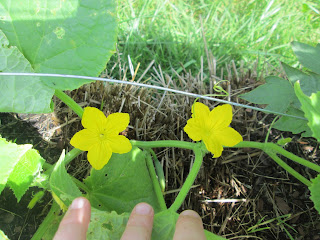
The cucumber plants began to flower. These are staminate male flowers. They show up before the carpellate females. This is so their pollen attracts bees (etc). 

By the time the females arrive, the cucumber plants are on the daily route of several pollinators - increasing the success rate of pollination and fruit production.


This year we have only noticed a single honeybee in our yard. Last year we had just four. This year only one, and he nearly drowned in the pool. Thankfully we saved him in time. We have plenty of wasps, but they honey bees are disappearing. Why do I mention it? 

This is tragic proof of the mass die-off that has been taking place.

Honey bees are vital to the pollination and success of plant growth, from flowers to home gardens like ours, to massive fields of America's life-sustaining crops. Companies like Monsanto are messing with the foods you consume every day. Their GMO's and pesticides are highly suspected to be behind the mass die-off that the honey bee colonies are facing. 

Look it up, friends. This is a real problem. It is not just dangerous to honeybees, it is dangerous to us. Food brought to you by the same companies who created Agent Orange. Look it up. Learn, research, and then find out what you can do to help stop this tragedy. If Obi Wan (hubs) and the HOA were okay with it, Giraffe and I would start bee keeping tomorrow.


June 20th saw the flowering and growth of our green beans, as well. I planted too many of these too close together. Oddly enough, they don't seem to mind the proximity of their neighbors and are doing very well. 


June 22nd was the last time I took photos for the month. I briefly lost my camera after that, thanks to Koala. :) I have only this final photo to share.

Tomato flowers, like other plants, contain pollen. Other plants carry their pollen on the outside of stamen growing one each inside of male flowers. Tomatoes have anthers instead of stamen: hollow tubes which have pollen inside. These anthers require vibration in order to release the pollen, which then sticks to the stigma. From there, the pollen grains grow tubes to the seeds and fertilize them. It is a fascinating process! 


Usually, the vibration of bees is enough to accomplish this. Even the soft brush of the wind can accomplish this (although not to great effect). The more seeds that are fertilized, the more fleshy the fruit. Humans have taken to providing vibration in a variety of ways to ensure good fruit production. One might 'spank' the tomatoes (as you can see Giraffe doing here) to provide vibration in the stems. You could also hold a vibrating toothbrush against the stems, or tape a pencil lightly against them. Mind you, this is never done hard enough to damage any part of the plant at any time. 

There you have it! :) We have caught up on updating the 2015 straw bale garden effort for the month of June! :)

Thursday, July 10, 2014

Of Pumpkins and Pollination

Of Pumpkins and Pollination

My pumpkins are out of control! haha At least, that is how it feels some days. They are wild and sprawling all over my yard and the other plants and I wouldn't have it any other way! I am absolutely delighted by them!

The picture at the top of the page is from this morning, while these other two first photos are about a week old. My pumpkin plants have grown even more and are taking up even more space now.
What merits this pumpkin-specific blog, you ask? Why am I prompted to keep gushing about them when I've already updated? Well, let me tell you. It turns out that they are mildly complicated little things! A while back I googled 'growing pumpkins' so that I could make a mental list of what all we are doing wrong and try to right it. 


I was fascinated to learn that pumpkins are different from their cucumber and tomato garden-buddies, in that a pumpkin blossom doesn't just die as a baby pumpkin grows. Far from it, in fact. Pumpkin blossoms have a gender! They are specifically male or female! 

Take a look at the pumpkin blossom in the picture to the right. Notice the long thin stem growing straight into a yellow blossom. :) 

This slender stem is known as the MALE pumpkin. These are the first to grow in a pumpkin plant. It is said that they serve the purpose of luring bees to the plant for pollination. The idea is that by the time the female blossoms mature and open, the plant is on the daily route of bees and has a better chance to be pollinated. 

That thought intrigued me greatly, and seemed a wonderful feat of nature. What, I wondered, does a female pumpkin blossom look like? 

It turns out that, true to my own life, the males are lean and the females are plump! lol Note the approximately golf-ball-sized green ball at the bottom of this blossom? That is what is called an ovary. 

This ovary looks like a baby pumpkin, and for good reason. If the female blossom is pollinated, the ovary becomes fertilized and will grow into the pumpkin fruit. Who knew?


We discovered the female blossom and her ovary/pumpkin in waiting pictured here too late to do anything about them. 

As of this morning the blossom has dropped off of the ovary and we are waiting with baited breath to see if she begins to grow into a fruit in the next four days or simply drops off, unfertilized. 

Come on! Are we pregnant or not!?!?!


I was so inspired by this little girl (and her two other tiny friends we just discovered a day or so ago) that I decided to look up this whole male/female thing again. This time I read articles and I watched videos on YouTube. I ended up running across countless videos about how to pollinate your own pumpkin blossoms by hand. Wow! You mean that I can make pumpkins happen all on my lonesome??? Of course I am going to try it! 

I learned that female blossoms open first thing in the morning and are only available for a few hours, so I went out this morning to take a peek. OH MY SOUL!! I have not one but TWO more pumpkin gals right up front that I did not even know were there! I MUST pollinate these suckers right away!! How did I miss them, when the differences are so obvious? They are sitting on the grass and while I do look at my pumpkins, I haven't been handling them (so as not to disturb them). Anyway, back to the business at hand. 

These females were apparent, not because of their swollen ovaries (hidden in the grass beneath them), but because of their carpels. 

The carpels (seen here in the very center of the blossom) are the little prongs growing out of the middle of the flower. They're growing directly out of the bottom of the ovary. 

This pumpkin flower has six carpels. 


These carpels need to have really good contact with pollen in order to fertilize the pumpkin (ovary) behind the blossom and encourage growth. 

This pollen comes from the stamen of a male plant. Notice on the right how the male plant has but one prong in the center? That is the stamen, and it is covered in the fluffy yellow pollen that bees crave so intensely. Speaking of which....

This is a honey bee. :) They are in short supply these days because there are fewer flowers, and in general pesticides have caused them to get sick. Entire hives can die from it. This is why we use only organic pest control in our garden.

I was concerned because I have seen sweat bees, carpenter bees, wasps and the like, but not a single honey bee. This morning I found four of them dancing around my garden! 


Now, do I think the world population of bees is suddenly going to disappear? No. Do I think it is my responsibility as a human being and as a child of God to care tenderly for His creations? I do! In fact, I link it to being good stewards of God's planet. :) We may use the planet, but let's take care of it, shall we? One doesn't have to fear that we're trashing the earth to extinction to care about how we treat it. Okay, back off of the soap box. ;)

As gently as I could, I collected a male pumpkin blossom and removed the petals. The idea is to do this carefully so that you do not knock the pollen off of the stamen.

Once the stamen was exposed and the stem had the look of a paint brush, I gently 'painted' pollen from the stamen on and around the carpels of the female blossom. You can see here I made sure to brush the inside as well as the outside. :)

Ideally, I would have liked to use two male blossoms for each of the female flowers I hand-pollinated... BUT there is the matter of my sweet little friends the honey bees. 

When I approached they became a little bit erratic. By the time I had stolen a blossom and stripped it of the petals, they were getting anxious. While I was pollinating the first flower, they were freaking out around my head and ears telling me in no uncertain terms "BUZZ OFF!!!" hehe

I finished hand pollinating with one flower for each female, and headed around the back of the bales to get a couple more male blossoms that had good, thick pollen on them... aaaand then noticed that the sweet little bees were in full-on freak out mode. In fact, they pounced on the next blossom I was after, and three of them went at it! I got a video of their angry little bee fight. When they fell off in a bee ball, I took my bare toes as far away from that patch of grass as I could. lol 


Did my girlies get fertilized? Will I have two precious little pumpkins to show for my care and concern? I am honestly not sure. We'll know in a few days (hopefully), and I'll be sure to tell you.  Maybe next time I will get to use two stamens for each set of carpels, and gently tie the petals closed so the bees can't steal the pollen away from the female blossom... we'll see. In the meantime, I have learned a lot and had a truly interesting and unique experience.